2026–2027 NATIONAL PROGRAM
HSBDC Program Details & FAQs
Everything You Need to Prepare for the Challenge
Review eligibility, key dates, research requirements, conference information, publication, awards and program policies for the 2026–2027 National High School Big Data & AI Challenge.
About the National High School Big Data & AI Challenge
The National High School Big Data & AI Challenge (HSBDC) is an interdisciplinary experiential-learning program in which high school and CEGEP students use open data, satellite intelligence and artificial intelligence to investigate real-world environmental challenges.

Students work to develop an original research question, analyze scholarly literature and real-world datasets, carry out their own data science and AI investigation, and interpret their findings and propose evidence-based solutions.

They communicate their work through scholarly writing in English and French, a digital poster and a conference presentation.
HSBDC strengthens problem-solving, computational thinking, data analytics, scientific research and science communication skills while putting participants ahead in competitive university applications.
United Nations’ Sustainable Development Goal 2: Zero Hunger
2026–2027 Challenge Theme
Preserving Biodiversity and Advancing Land’s Environmental Resilience Using Open Data, Satellite Intelligence and AI
Climate change is increasing the frequency and severity of invasive species outbreaks and wildfires, threatening communities, ecosystems, biodiversity and critical infrastructure. Satellite intelligence, open environmental data and AI provide new tools to monitor ecosystem health, detect warning signs, assess risk and support evidence-based decisions.
Challenge participants investigate a research question of their choice and may analyze satellite imagery, climate, land-cover, biodiversity, demographic or socioeconomic data. Their goal is to identify patterns, predict risks and propose sustainable, data-driven solutions that support climate adaptation, biodiversity conservation and resilient communities.
What students will do
Formulate a Research Question
Develop an original research question related to biodiversity and land environmental resilience.
Agile Team Research Planning
Work in an agile team and organize an inquiry-driven research project.
Scholarly & Data Analysis
Analyze scholarly journals’ publications on the topic of interest, find and crunch real-world open datasets using data analytics and AI methods.
Evidence‑Based Interpretation
Interpret findings and propose practical, evidence-based solutions.
Full Research Output Preparation
Prepare a research project report (manuscript) with abstract, 5-min video, and poster for the academic conference presentation.
National Conference Participation
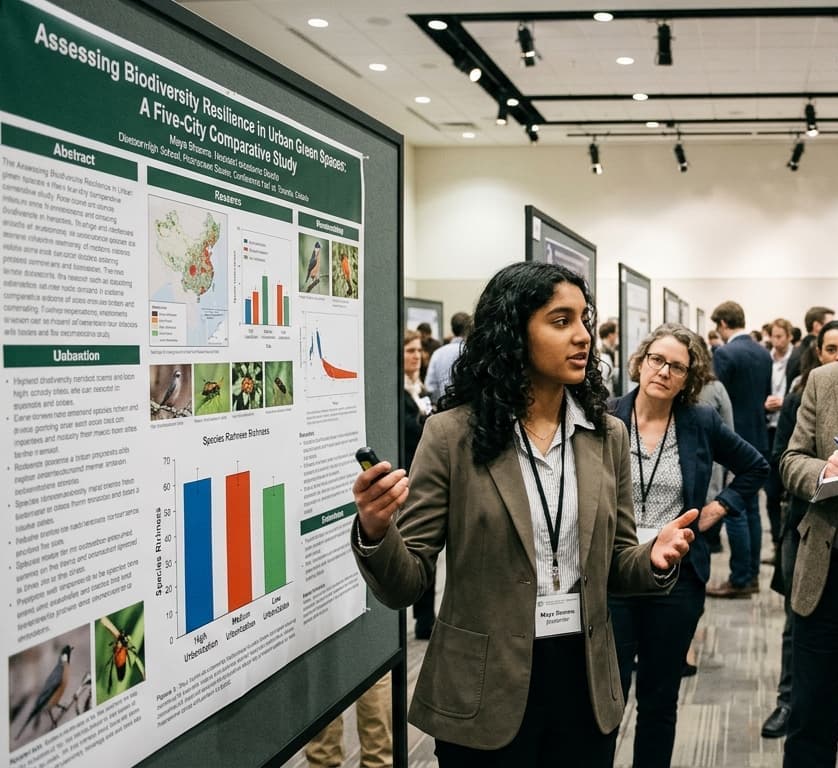
Take part in the national scholarly conference competing for the awards with a three-minute thesis presentation and poster in front of academia and industry leaders.
Explore sample research directions
Predicting wildfire risk using satellite-derived environmental indicators
Mapping the impact of climate change on wildfire frequency and intensity
Analyzing infrastructure vulnerability to invasive species using geospatial data
Evaluating early wildfire or invasive-species detection systems using satellite imagery
Designing data-driven land-management strategies that strengthen land resilience
Compare HSBDC pathways
Program feature
Registration
Team structure
Learning model
Instruction and support
Certification
Best fit
Fee
Scholar Internship Pathway
Individual registration
Students register individually and work in interdisciplinary agile research teams
Four-month blended learning with weekly university academic sessions and rigorous data science and research curriculum
Weekly university academic instruction, Cisco data science training and certification, scholarly mentorship and agile teamwork
Cisco Academy Data Science training and certification; Scholarly communication capstone; Agile teamwork
Students seeking university experience, research certification and mentorship
$980
per participant
Scholar Internship Pathway
Independent Research Pathway
Team registration
Teams of up to five students
Independent team-led research supported by program resources
Recorded workshops on selected topics; open-access datasets and tools; self-paced team workflow
N/A
Student teams prepared to organize and manage an independent research project
$250
per team
Independent Research
Both pathways include conference opportunities, publication of team abstracts in the STEM Fellowship Journal conference proceedings, and eligibility for awards. No prior programming experience is required.
Important dates
September 1, 2026
Registration opens
October 18, 2026 at 11:59 PM ET
Registration deadline
October 18, 2026 – January 10, 2027
Program and research period
January 10, 2027 at 11:59 PM ET
Manuscript deadline
January 17, 2027 at 11:59 PM ET
Poster and slide deadline
February 12, 2027
Toronto conference, Hart House, University of Toronto
February 2027
Calgary and Montreal conferences - final dates to be announced
The date will be announced
Program Q&A session
STEM Fellowship owl mascot teaching with pointer symbolizing guidance and education
Frequently Asked Questions
1. What is the National High School Big Data & AI Challenge?
HSBDC is an interdisciplinary inquiry/research program combining math, environmental studies, computer science, business, English/French writing, and social sciences in which high school and CEGEP students use open data, satellite intelligence and AI to investigate a real-world environmental question and communicate their research findings. The program equips its participants with digital scholarly investigation skills and experience and sets them apart in competitive university applications.
2. What research topics can students explore?
This year, in collaboration with project partners including the Nature Conservancy of Canada, we invite students to tackle the issues of biodiversity and environmental resilience of land. Research may focus on wildfire risk, climate impacts, invasive species, satellite-based detection systems, biodiversity or data-driven land-management strategies.
3. What does each team submit?
Each team submits a research abstract, manuscript, 5-minute YouTube research pitch, and digital poster. Teams also prepare a physical research poster and three-minute/one slide thesis presentation for conference participation.
4. Will student work be published?
Team abstracts are published in the peer-reviewed academic STEM Fellowship Journal as part of the conference proceedings. The full manuscript of the winning team of the scholarly publication award gets published as a separate paper.

Those interested in scholarly publication of their full project report are welcomed to submit through the Journal’s standard editorial process.
5. Are awards available?
Yes. Participants are eligible for research-poster, three-minute thesis presentation and manuscript awards. Final prize amounts and award conditions will be published when confirmed.
6. May participants choose their regional conference?
Yes. Participants may choose the national conference they would like to participate in. Unfortunately, multiple conference participation is not budgeted in the participation fees.
7. Is conference attendance required?
Conference attendance is optional. It is required to compete for prizes. Abstract publication in the conference proceedings does not depend on attending the conference event.
8. When is registration and payment due?
Registration and payment are due October 18, 2026, at 11:59 PM ET.
9. What is the cancellation deadline?
Participants may cancel the program by October 17, 2026, at 11:59 PM ET.
10. Where can I find pathway-specific fees and learning details?
Pathway-specific fees, learning models, support and registration information are provided on the Scholar Internship Pathway and Independent Research Pathway pages.
11. What is included in the Scholar Internship fee?
The $980 Scholar Internship pathway fee includes: CISCO Academy Data Science Essentials with Python course and certification; mentored research ideation, literature review, open data search and analysis, and data visualization; academic instruction in scientific writing and communication; conference participation costs and scholarly publication of abstract in the conference proceedings.
12. What does the Scholar Internship blended-learning format include?
The Scholar Internship pathway combines weekly university academic sessions with CISCO Academy online learning and Google Classroom recorded workshops and program management. It includes data science instruction, original research mentorship, agile teamwork coordination, and guided academic project development.
13. How can Scholar Internship strengthen a student’s academic portfolio?
Students complete an original research project, earn a data science credential, develop a manuscript and research poster, prepare an academic conference presentation, and get a DOI number for the publication of their abstract in the conference proceedings. The combination of the above research, analytical, science communication and teamwork skills forms a strong academic achievement portfolio for university application.
14. How are responsibilities managed within an Independent Research team?
Independent Research teams organize their own workflow, assign responsibilities and manage project milestones. Students should establish clear roles for research, data analysis, writing, project coordination and presentation development.
15. What is included in theIndependent Research Pathway fee?
Independent Research pathway includes recorded workshops on selected topics; open-access datasets and tools; and conference participation along with publication of project abstracts in the conference proceedings.
Choose your HSBDC pathway
Review the Scholar Internship and Independent Research pages to compare pathway-specific learning models, support and registration information.